How does one create new data visualisations? Apart from the art, is there a science to it?
Let’s explore a few popular charts. We have the vertical bar graph
The first thing you’ll observe is that all of these are a series of rectangles. (We’re treating the dots on the scatterplot as little squares.) The only thing that varies across these charts is the position and size of the rectangles – and the colour as well.
That gives us a hint. Perhaps there are many ways of creating visualisations just by changing the position, size and colour of rectangles. For example the horizontal bar graph
Whereas, if we look at a horizontal stacked bar
Generalising this, we can construct a table like this that shows the structure of various visualisations:
| Chart | x | width | y | height | colour |
|---|---|---|---|---|---|
| Vertical bar chart | index | constant | constant | value | constant |
| Stacked bar | index | constant | cumulative | value | index |
| Waterfall | index | constant | cumulative | value | constant |
| Scatterplot | value | constant | value | constant | index |
| Horizontal bar chart | constant | value | index | constant | constant |
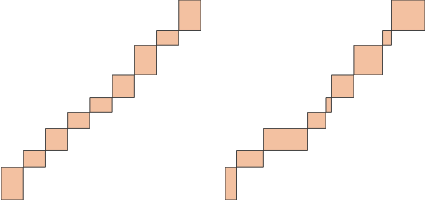
| Variwide | cumulative | value | constant | value | constant |
That leads to a line of thought: what if we tweaked this table? Would we get new visualisations that might be interesting?
Let’s experiment with a few.
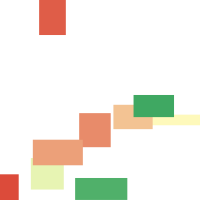
This chart can, for example, show the position and spread of two metrics. For example, if the X-axis were sales, and the Y-axis were price, each bar could be the distribution of price and sales in a branch, with the colour indicating growth of the branch.
Just using the combinations discussed above, there are 75 possible types of visualisations – many of which are meaningful in different circumstances. And this is just using rectangles.
What we’ve done here is mapped data to attributes of a visualisation. This is part of a generalised approach to graphics, similar to that covered by Leland Wilkinson’s Grammar of Graphics and implemented in libraries like ggplot2 or D3. Once we establish that basic concept – that a chart is a mapping of attributes to data – the variety of charts you’ll be able to create is unlimited, and you move from being a user of charts to a composer of data-driven visualisations.
Industry 4.0 solutions originally had their genesis in manufacturing. “The Fourth Industrial Revolution, Industry 4.0,… Read More
Improvement in production performance can enhance supply chain efficacy. There is a continuous discourse around… Read More
Sshhhhhh, ChatGPT knows everything!! In 2023, Generative AI (GenAI) emerged as a major technology disruption… Read More
Generative AI holds immense promise for healthcare, leveraging large datasets to innovate medical imaging, treatment… Read More
NJBIZ has recognized Naveen Gattu, Founder and Chief Operating Officer of Gramener—A Straive Company, as… Read More
This website uses cookies.



Leave a Comment